
Playtime 14
April 13-April 19, 2026

This is PLAYTIME, a weekly email of theater shows in New York City, put together by me (Nora) and consisting of what I’m paying attention to and excited about.
This week, my friend Ezra Glenn wrote a guest post for us about attending two back-to-back musicals in a single weekend, which, to me, is very brave. As with everything Ezra does, the essay is thoughtful, funny, and insightful. As always, listings are below. This is our first guest essay and a total thrill.
“Schmigadoon” and “No Singing in the Navy”: Two Golden Age parodies strike opposing chords
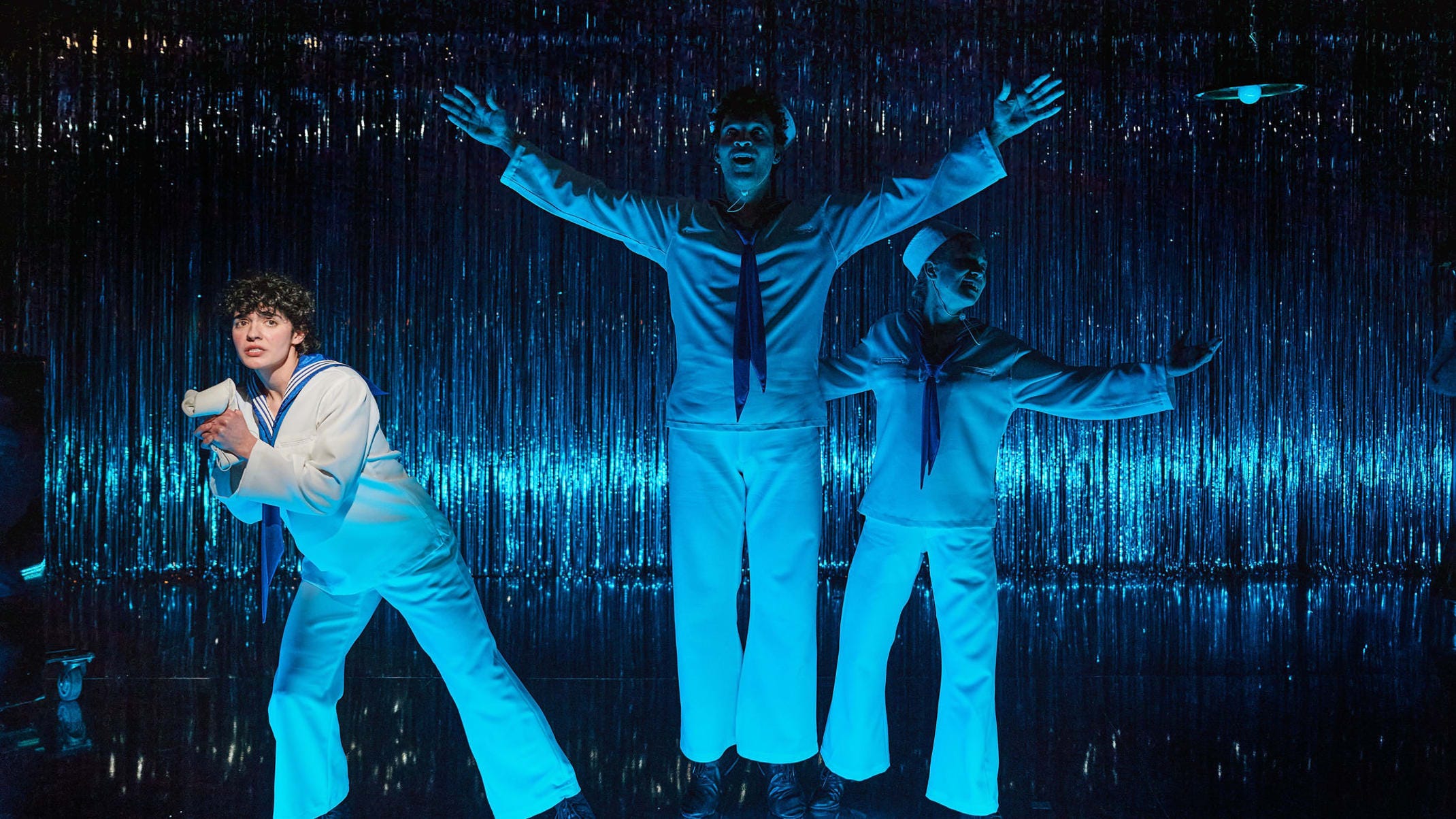
Last weekend I traveled to Times Square twice in less than 24 hours to see two pieces of theater about which I knew very little before arriving at their respective theaters. The first was Schmigadoon, based on the 2021 inaugural season of the Apple TV+ series of the same name, which began its run of Broadway previews before my very eyes at the Nederlander Theater on 42nd Street on Saturday night, April 4. I then caught an Easter Sunday matinee of No Singing in the Navy at Playwrights Horizons’ Peter Jay Sharpe Theater on 41st Street, which just announced an extension of its run through April 26.
There were striking thematic overlaps across the productions; both turned out to be new musicals about the joy of song, which leaned heavily on the sound of the familiar. Both have been called parodies of Broadway’s “Golden Age,” the musicals of the 1940s and 50s often championing an “American Dream” of Protestant ideals. The dramaturgical approaches of the two shows and their takeaways for their audiences, however, were diametrically opposed.
I knew nothing of Schmigadoon before I arrived to meet my siblings for the show, nor of Brigadoon, the 1947 musical from which it borrows its name and concept. The contemporary show is about a couple who met at work in New York City and are now engaged, but struggling to make each other happy. Working through their differences brings them to a wilderness couples retreat, where they get lost in the forest and cross a bridge to discover the show’s namesake town, where life is a musical. This is a joy for the female lead, Sarah, who loves musicals, and miserable for her fiancé, Josh, who hates them. In order to cross back over the enchanted bridge and return to their real lives, they must find true love. Their first several attempts to leave together end in failure, putting them right back where they started on the Schmigadoon side of the bridge despite having walked across it. So they split up and look for love among the townspeople, which leads them both to nearly falling for other people and brushes with death. It’s a hokey journey that ends when Josh finally embraces song into his life, realizes he does truly love Sarah, and she loves him back. The end.
“No Singing in the Navy” is the more inventive – and more existential – of the two. Three actors in sailors’ uniforms remain onstage for the duration of the 80-minute piece, alongside a pianist who provides the sole instrumental accompaniment to their (often sung) dialogue as they explore the meaning of life, war, and death. In its opening moments, we learn that these three young Americans, clad in white uniforms and blue neckerchiefs, have been drafted into the Navy and have 24 hours before they are shipped off to war. The sailors are assured they will die at sea regardless of the war’s aims or outcome. One rule is imposed early in the show’s single act by the gnarled captain, played by Sailor 2, swapping out their Dixie Cup for a cocked cap: There will be no singing, and to carry a tune is punishable by death. There is, in fact, a lot of singing (including by the captain, alone in his quarters as he pines for the silly sailors he’s consigned to death), mostly to the tunes of nursery rhymes and simple scales that call to mind various childhood refrains: Miss Mary Mack looms large here. As the players count down the hours remaining until their assured deaths, they harmonize endlessly, wax rhapsodic about their hopes and dreams, and ponder what it means to approach the end of a life where these will remain unrealized. Some of the most poignant moments of the show explore why singing (outside of performance or recordings) is often considered “weird,” “silly,” or for “losers,” and why our teachers, our Captains, and our bullies may try to keep us from that kind of free, joyful expression.
Schmiggadoon’s musical numbers were well performed, if not quite catchy. While its songs are original (mostly adapted from the TV show), they are endlessly referential in tune, lyrics, and themes to shows like Oklahoma, Guys and Dolls, Carousel, and The Sound of Music. The show was a spectacle, but it was not spectacular. Far from transported to the land of Schmigadoon with its trademark corn pudding piled high on every plate, I was all too aware of the narrowness and uncomfortable angles of my velvet seat for the duration of its near 3 hour runtime. I watched the show with the playbill open in my lap, counting the musical numbers as they passed, edging me closer to what I knew early on would be a tiresome and uninspired conclusion.
While No Singing’s original songs also relied heavily on borrowed melodies, there was a freshness and delight to each number. Though the set consisted of only a tinsel-coated perimeter, an onstage costume rack for the actors’ many quick changes as they inhabited a revolving door of side characters (the aforementioned captain, a spirited crab, a long lost love in a lighthouse), and a piano which served as a frequent perch for singing (and drama), clever lighting and winning performances electrified the space, bringing the audience all to sea, to shore, to war, and back again without so much as a fadeout.
Playwright Milo Cramer manages to keep things silly enough while also offering some timely commentary on the American obsession with war, casting a critical and incisive light on the sailor-focused American musicals of the post-WWII “Golden Age” (See: On the Town, South Pacific, Dames at Sea): were these, too, silly love stories on the water, or were they propaganda for the War Machine? Though both shows parody the same source material, Schmigadoon is an embrace of the era in which every story seems to end with a man and a woman leaving city life – or military life – to start a family in the suburbs, while No Singing is a welcome rebuke.
These two shows were never meant to be in conversation, and yet here they are playing concurrently, three blocks apart, referencing the same canon and driving home the same point: song is freedom. Schmigadoon will be up for a Tony or two as one of the year’s “original” musicals, with a threat of a follow-up staging of the TV show’s second season (the third season was written but never aired, and there are whispers of bringing that to Broadway, too). No Singing in the Navy, far more original in its contrasting depth and playfulness, buttressed by a doughty trio of dramatic and vocal performances, is at Playwright’s Horizons through April 26th, and probably nowhere else ever again. There’s as much joy in catching a great, ephemeral performance as there is in singing out loud and proud, if not more.
Week of April 13, 2026
Cherry Lane Theatre You Got Older (through April 26)
DR2 Theater Heartbreak Hotel (through April 19)
Greenwich House Theater What We Did Before Our Moth Days (through May 24)
Greenwich House Theater Wallace Shawn performs “The Fever” (Sunday and Monday nights through April 20)
Irish Repertory Theatre Ulster American (through May 10)
Lucille Lortel Theatre Kenrex — (first preview April 15, opens April 26)
Minetta Lane Theatre Sexual Misconduct of the Middle Classes (through April 30)
Minetta Lane Theatre What Happened Was… (opens April 14)
New York Theatre Workshop My Joy Is Heavy (extended through April 12)
Playwrights Horizons (The Peter Jay Sharp Theater) No Singing in the Navy (through April 19)
Playwrights Horizons / Peter Jay Sharp Theatre Rheology (opens April 14)
Second Stage / Irene Diamond Stage The Receptionist (first preview April 15, opens May 7)
St. Ann's Warehouse SCORCHED EARTH (through April 19)
Soho Playhouse Ismael Loufti: Heavenly Baba (through April 25th)
The Public Theater / LuEsther Hall SEAGULL: TRUE STORY (through May 3)
Theatre at St. Clement’s The Adding Machine (opens April 14)
A bit about the listings:
The events are listed in alphabetical order of theatres. When a show is listed as “through” a certain date, the show has already opened.
For festivals, I’ve only highlighted certain shows and there’s usually a lot more happening. Check the full lineups on their websites.
I’ve done my best to get everything right, but details can change. Always double-check the official event page for the latest times, dates, and any updates.
If you’d like to submit a show to be added to Playtime email playtime@substack.com
Read my personal thoughts and god knows what else on my other Substack here.